 admin
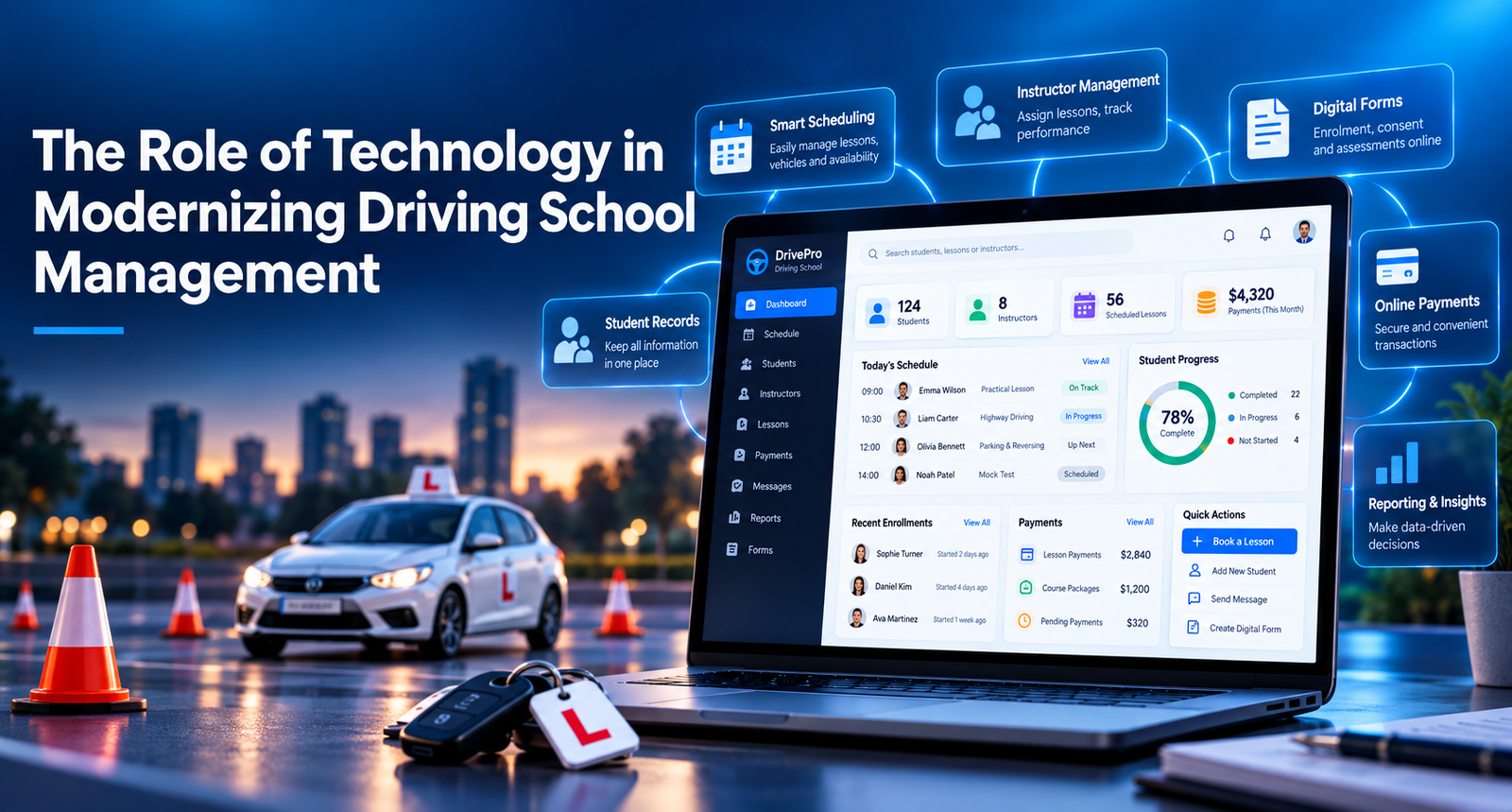
Ask a long-time driving school owner how they once ran the business and you will likely hear about appointment books, carbon-copy receipts and a wall calendar marked in three colors of pen. Management meant memory: knowing which instructor preferred mornings, which student still owed for two lessons and which car was due for an oil change.
Today, that knowledge is too valuable to keep in one person’s head. Modern driving school management software turns it into shared, up-to-date information that the whole team can act on, whether the owner is in the office or not.
The shift is easiest to see in how lessons are booked. A school using schedule to drive scheduling software lets students reserve and pay for lessons online at any hour, so bookings keep coming in even when the office is closed.
But technology’s role in management goes well beyond booking. It changes how owners delegate, how they measure performance and how they plan for growth.
How Driving School Management Has Evolved
The Paper Era
Everything lived in notebooks and filing cabinets. It was simple and cheap, but the business depended on whoever kept the books, and very little could be analyzed.
The Spreadsheet Era
Spreadsheets brought some order, but they also multiplied. One file held students, another tracked instructor hours and a third logged payments. Keeping them consistent became a job in itself.
The Connected Platform Era
Today’s systems link the office, instructors and students in real time. A change made in one place shows up everywhere, which means managers spend less time reconciling information and more time using it.
From Doing the Work to Overseeing It
The biggest change technology brings is to the owner’s role. In a manual school, the owner often is the system: the person who approves every change and remembers every exception. Technology lets those rules be set once and applied automatically, so the owner can delegate with confidence.
In practice, cancellation and rescheduling policies apply to every booking without someone enforcing them by hand. Instructors manage their own availability within limits the school defines. Office staff handle the exceptions instead of the routine requests.
Managing With Data Instead of Guesswork
When lessons, payments and instructor activity are recorded as they happen, the business starts producing useful information on its own. Managers can answer questions that used to take a weekend with a calculator:
- Which instructors are fully booked, and which have room for more students?
- Which lesson packages are most popular, and which rarely sell?
- When do cancellations happen most, and is a policy change needed?
- How does revenue at one location compare with another?
None of these answers needs a data team. They come from reports built on information the school is already capturing every day.
Keeping the School Audit-Ready
Driver education is a regulated field, and record-keeping requirements vary by state. Technology does not remove that responsibility, but it makes it much easier to meet. When training hours, lesson notes and student documents are recorded at the time of the lesson, the school builds a complete record as it goes, rather than reconstructing one when an inspector or a parent asks for it.
Building a Technology Roadmap in Phases
Modernizing management works best as a series of stages rather than one big switch.
Phase 1: Get the Foundations in Place
Bring student records, the lesson schedule and payments into one system. This alone removes most of the double entry that slows the office down.
Phase 2: Automate the Routine
Turn on online booking, automatic reminders and self-service for students and parents, so everyday requests no longer need a staff member.
Phase 3: Use the Data to Grow
With reliable information in place, use reports to guide decisions about hiring, pricing, new lesson types or opening another location.
Off-the-Shelf or Built Around Your School?
One of the bigger decisions is whether to adopt a standard tool or invest in a platform shaped to the school’s own way of working. Standard tools can be quick to start with, but they ask every school to follow the same workflow. A customized platform takes more planning upfront, but it follows the school’s existing rules, branding and processes.
This is the kind of work that software development firms such as NewAgeSysIT focus on. As a custom software and mobile app development company and a proud supporter of the Driving School Association of the Americas (DSAA), NewAgeSysIT starts from a ready platform and adapts it to each school’s workflows, so owners are not forced to change how they operate to fit the software. Whichever route a school takes, the right choice is the one that matches how it runs today and where it plans to be in a few years.
Conclusion
Technology has changed driving school management from a job of remembering and reconciling into one of overseeing and deciding. Owners who modernize gain clearer visibility, more confident delegation and better information for planning ahead, while instructors and office staff spend less time chasing details. The most effective approach is gradual: build a solid foundation, automate the repetitive work, and then let the data guide the school’s next move.