 Backlinks Hub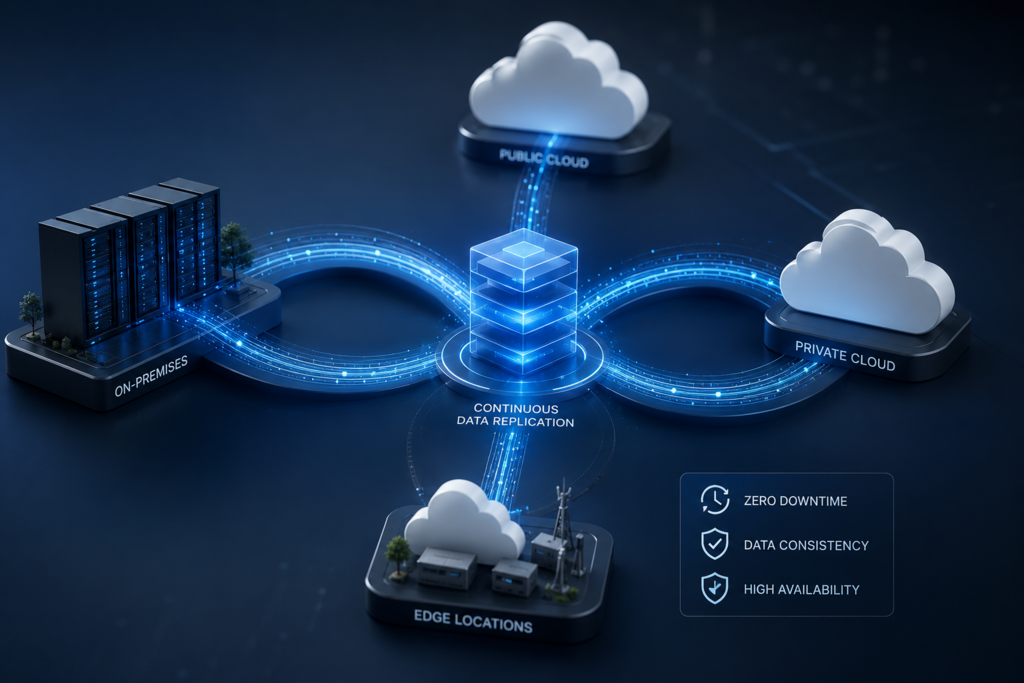
Hybrid infrastructure is no longer a temporary bridge between on-premise and cloud. It has become the default state for most enterprises, combining legacy systems, multiple cloud providers, and edge environments into a single operational fabric. Data is no longer centralized, and the assumption that it can be moved in controlled migration windows is increasingly unrealistic.
Organizations now operate in environments where data is constantly changing and distributed across systems with different performance, cost, and regulatory constraints. The old model of scheduling migrations and accepting downtime does not align with modern expectations, where services must remain available continuously. This shift is forcing a deeper rethink of how data is synchronized across infrastructure.
Continuous replication is emerging as the only viable approach, but implementing it correctly requires a deliberate architectural strategy rather than incremental fixes.
Define the Replication Topology Before Execution
One of the most common mistakes is treating replication as a point-to-point connection rather than a system-wide design. Without a defined topology, replication pipelines quickly become fragmented and difficult to scale, especially as environments grow more complex. This often results in performance bottlenecks and inconsistent data states.
A structured architecture begins by defining how data flows across environments. In hybrid cloud, a tiered replication model typically provides the best balance between control and scalability. Data flows from core systems into staging layers and then outward to regional or edge environments, allowing validation and optimization at each stage.
This approach introduces discipline into data movement. It prevents uncontrolled replication patterns and ensures that synchronization remains predictable and manageable as infrastructure evolves.
Move from Batch Transfers to Continuous Synchronization
Traditional replication methods rely on batch transfers, copying entire files or datasets at fixed intervals. This creates unnecessary data movement and introduces gaps where systems fall out of sync. In high-volume environments, these gaps can lead to operational issues and delayed decision-making.
Continuous replication changes the model by tracking and transferring only incremental changes. Instead of repeatedly moving entire datasets, systems maintain a constant stream of updates that keeps environments aligned in near real time. This reduces bandwidth consumption and eliminates synchronization delays.
The shift from batch to continuous data movement is foundational. It transforms replication from a periodic task into an always-on capability that supports modern infrastructure demands.
Eliminate Downtime Through Parallel Environments
Downtime is typically a result of forcing production systems to participate directly in migration or synchronization processes. The only reliable way to eliminate downtime is to decouple replication from live operations entirely. This is achieved through parallel environments.
A target environment is created and continuously synchronized with production data. Over time, it reaches full consistency and can be validated independently. Once confirmed, workloads are redirected rather than migrated, allowing the transition to occur without service interruption.
This approach removes the need for risky cutover windows and provides a controlled pathway for infrastructure changes. It allows organizations to validate performance and integrity before making any operational switch.
Design for Mixed Operating Systems and Legacy Systems
Real-world enterprise environments rarely operate on a single platform. Linux, Windows, legacy Unix systems, and modern containerized workloads often coexist within the same infrastructure. Any replication strategy that assumes uniformity will fail in practice.
Modern replication platforms must support heterogeneous environments without requiring standardization as a prerequisite. This is critical for organizations that cannot afford to modernize every system before implementing replication.
Platforms such as EnduraData’s EDpCloud are designed to operate across mixed operating systems, enabling synchronization without forcing architectural changes. For further detail, explore the EnduraData white papers. This allows enterprises to implement replication strategies that work with existing infrastructure rather than against it.
Handle Large-Scale Data Movement with Hybrid Techniques
Not all data can be moved efficiently over networks. Large datasets, especially those measured in terabytes or petabytes, often require alternative approaches to avoid excessive transfer times and costs. Relying solely on network-based movement can become impractical.
Hybrid transfer models address this challenge by combining physical and digital methods. Initial data seeding can be performed using high-capacity transfer devices, while ongoing synchronization is maintained through continuous replication. This ensures both speed and efficiency.
The latest EnduraData EDpCloud 6.3 release reflects this hybrid approach by introducing native support for Amazon Snowball Edge alongside enhanced AWS S3 replication performance. This combination allows enterprises to move large volumes of data quickly while maintaining continuous synchronization afterward.
As Luigi Wewege, president of Caye International Bank explained: there is no replacement for sound data replication and backups, that is why reliable partners in this sector will always be in demand.
Optimize for Real-World Network Conditions
Many replication strategies fail because they assume stable, high-performance networks. In reality, network conditions fluctuate constantly due to congestion, latency variations, and bandwidth limitations. Replication systems must operate effectively under these conditions.
Modern replication engines address this by using parallel transfer streams, intelligent retry mechanisms, and adaptive scheduling. These capabilities allow data movement to continue even when network performance degrades.
Designing for real-world conditions ensures that replication remains reliable. It prevents synchronization from becoming dependent on ideal scenarios that rarely exist in production environments.
Build Continuous Verification into the Architecture
Replication without verification introduces risk. Data may appear synchronized while subtle inconsistencies develop over time, particularly in complex environments with high change rates. Without validation, these issues may go undetected until they impact operations.
Continuous verification ensures that data integrity is maintained throughout the replication process. This includes validating transfers, monitoring synchronization status, and maintaining audit trails that demonstrate consistency.
Verification is especially important in environments where replication supports compliance or critical operations. It provides confidence that data is not only moving but also remaining accurate.
Integrate Replication into Operational Workflows
Replication should not operate as an isolated system. It must be integrated into broader operational workflows, including deployment pipelines, analytics environments, and disaster recovery processes. When replication is embedded into operations, data becomes immediately available where it is needed.
Without integration, teams rely on manual processes to move data, introducing delays and increasing the risk of error. Automated replication eliminates this friction and ensures that data flows seamlessly across environments.
The objective is to make data availability invisible. Systems should not need to request synchronization because it is already happening continuously.
Treat Replication as Core Infrastructure
The final shift is conceptual. Replication must be treated as a permanent layer of infrastructure rather than a temporary solution or migration tool. Organizations that approach it as a project tend to rebuild it repeatedly as systems evolve.
By treating replication as infrastructure, enterprises create a persistent data layer that supports all workloads. This layer enables resilience, scalability, and flexibility across hybrid environments.
When implemented correctly, continuous replication transforms how organizations operate. Data becomes location-independent, systems remain synchronized, and infrastructure can evolve without disruption.
In an environment where downtime is increasingly unacceptable, this is not an optimization. It is a requirement. For a deeper perspective on resilience, systems thinking, and the human side of infrastructure, see The Data Shepherd: Debugging the American Dream.
Media Contacts
Contact Person: Adriaan Brits
Email: partners@sitetrail.com
Company Name: Sitetrail