 Sky Bloom IT
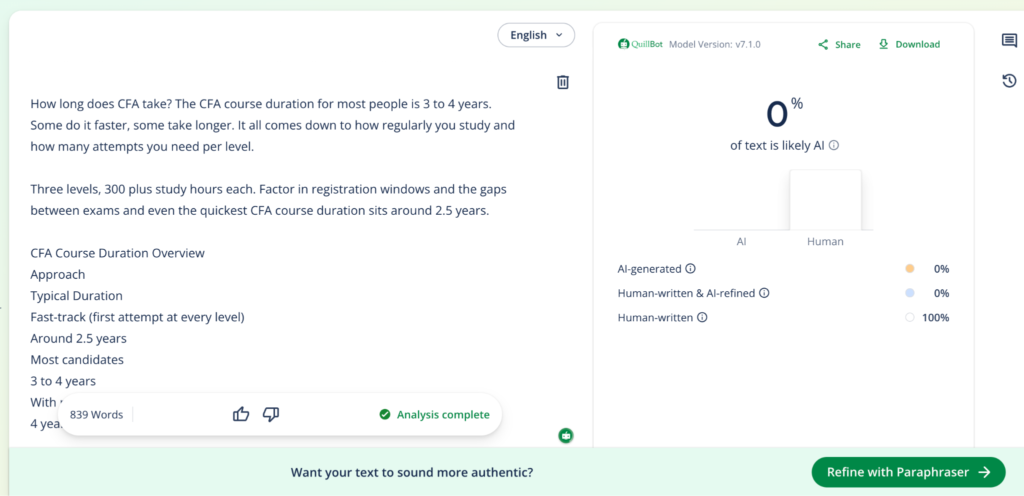
How long does CFA take? The CFA course duration for most people is 3 to 4 years. Some do it faster, some take longer. It all comes down to how regularly you study and how many attempts you need per level.
Three levels, 300 plus study hours each. Factor in registration windows and the gaps between exams and even the quickest CFA course duration sits around 2.5 years.
CFA Course Duration Overview
| Approach | Typical Duration |
| Fast-track (first attempt at every level) | Around 2.5 years |
| Most candidates | 3 to 4 years |
| With retakes or longer gaps | 4 years or more |
These timelines assume you are actively preparing and registering for the next level without long breaks. Candidates who take a year off between levels will naturally fall outside this range.
Level-wise Time Structure
| CFA Level | Average Study Hours | Exam Windows Available |
| Level 1 | 300 or more hours | February, May, August, November |
| Level 2 | 300 or more hours | May, August, November |
| Level 3 | 300 or more hours | February, August |
Level 1 is where you get your footing. Finance basics, accounting, ethics, economics. Level 2 gets harder fast. You stop just learning concepts and start applying them to company valuations and analysis cases.
CFA Level 3 is portfolio management heavy, with written answers mixed in. Most candidates say the jump from Level 1 to Level 2 is the biggest shock.
What Affects Your CFA Duration?
- How many hours per week you can study alongside college or work
- Whether you clear each level on the first attempt
- Which exam windows you choose and how early you register
- How much the CFA syllabus overlaps with your degree subjects
Candidates from finance or accounting backgrounds often find CFA Level 1 easier to navigate because the material overlaps with their degree. That said, Level 2 levels the playing field. The exam style changes significantly.
CFA After 12th: What the Timeline Looks Like
You cannot sit for CFA exams right after Class 12. The CFA Institute requires candidates to be within 23 months of completing a bachelor’s degree before registering for Level 1.
So the practical plan after 12th looks like this:
| Stage | What to Focus On |
| After Class 12 | Choose a finance-aligned degree like B.Com, BBA, or Economics |
| First year of college | Build accounting and economics basics through your degree |
| Second or third year | Register for CFA Level 1 once within the 23-month eligibility window |
| Post graduation | Continue Level 2 and Level 3 alongside your first job |
Most Indian candidates studying for CFA are in their second or third year of college when they begin Level 1 preparation. That is the standard path, not an exception.
CFA Course Duration in India
India follows the same CFA course duration as everywhere else. No local version, no special structure. Three levels, same syllabus, same exam windows.
Most Indian candidates juggle CFA prep with either college or a job. It works, but only with a set study routine. Waiting for free time that never comes is how most people fall behind.
- Test centers cover most major cities: Mumbai, Delhi, Bengaluru, Hyderabad, Chennai, Pune, Kolkata
- BFSI hiring for CFA-cleared profiles has picked up noticeably over the last few years
Mumbai is where most of the action is for CFA jobs. That is where the big AMCs, investment banks, and research desks sit. If front-office finance is the goal, being in Mumbai or open to moving there matters.
Career Outcomes After CFA
Clear all three CFA levels and you can go after roles in equity research, portfolio management, investment banking, risk, and wealth advisory. These are not entry-level titles either. CFA carries weight for mid and senior finance roles.
Common employers in India include Goldman Sachs, JP Morgan, HDFC AMC, ICICI Securities, Kotak Mahindra Bank, Deloitte, EY, and KPMG.
| Career Path | Typical Role |
| Equity research | Research Analyst covering sectors or companies |
| Portfolio management | Fund Manager or Portfolio Analyst at an AMC |
| Investment banking | Analyst or Associate in M and A or capital markets |
| Risk management | Risk Analyst or Credit Risk Manager |
| Wealth advisory | Wealth Manager or Financial Planner for HNI clients |
CFA charterholders with around six years of experience earn an average of INR 28.6 LPA according to CFA Institute’s own India Impact Assessment. Entry-level roles after Level 1 or Level 2 typically start at INR 5 to 12 LPA depending on the firm and city.
Other Finance Certifications to Know
CFA is not the only path in finance. Two others worth knowing:
- US CMA: good fit if you are heading toward corporate finance, budgeting, or management accounting
- ACCA: better suited for accounting, audit, and compliance roles with a global scope
Pick based on where you want to end up, not what seems popular. All three are solid credentials for different roles.
If you want to learn CFA, Zell Education offers a CFA course which is definitely worth checking out. They break the prep into level-wise schedules so you are not guessing how long each topic needs. Good fit if managing study time alongside work is the harder part for you.