 Blitz
Blitz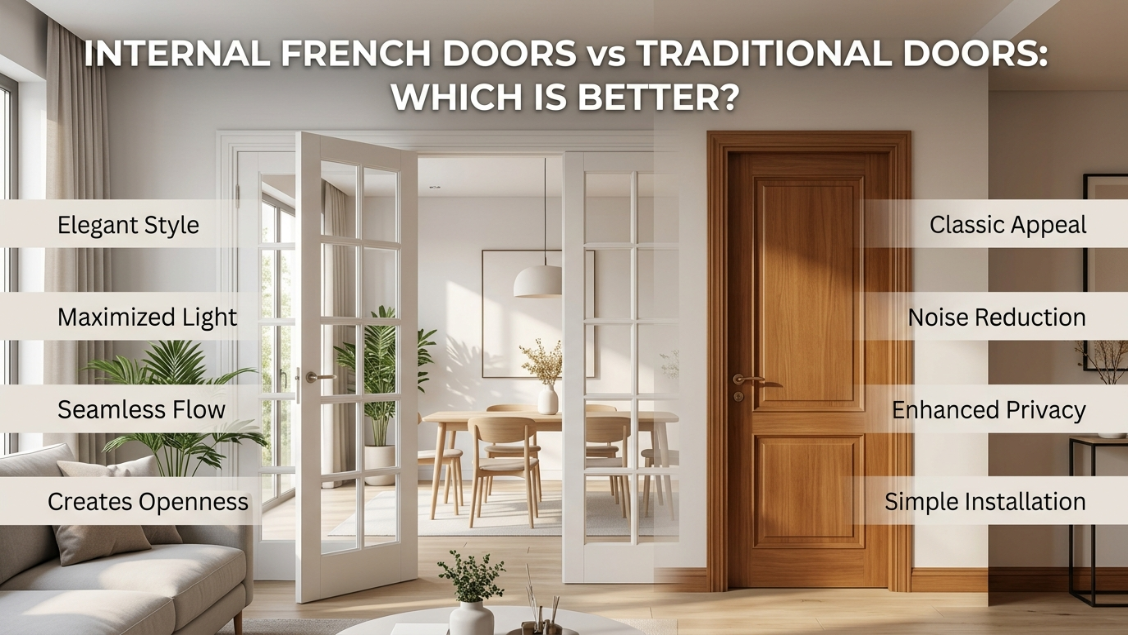
This is one of those choices where making improvements to your house seems easy at first, but the more you think about it, the harder it gets to decide. Should you go for a regular door which is practical and works well, or should you take the architectural route and have something more exciting? Well, the real truth is that it depends on the situation. But then again, it does make sense to go for glazed double doors for a lot of houses in the United Kingdom.
This isn’t about dismissing traditional doors. They’ve got genuine advantages in certain situations. It’s about understanding what each option actually offers so you can make the right call for your specific home and how you live in it.
What a Traditional Solid Door Does Well
Start with the basics. A good quality solid door performs its basic task rather well. It ensures full acoustic separation between rooms. It provides full darkness, important if you have a bedroom right next to your active living area. It offers full privacy. In terms of insulation properties, a solid door will retain heat in a particular room more efficiently than its glazed counterpart.
Then there’s also the cost factor. A standard solid wooden door is significantly cheaper than a custom-built one made of steel and glass. If you rent the property out, are building a house on budget, or simply need a room where the function calls for full isolation, then choosing a solid door is the way to go. And it is perfectly fine.
The maintenance required is minimal as well. Simply repaint it every couple of years. Change the hardware if it gets old and worn out. This is an item that does not require much care.
Then, why do so many homeowners in the UK opt to replace their solid doors with glazed ones? Simply because solid doors hinder their efforts to improve their home’s quality of life in those rooms and situations.
Where Traditional Doors Fall Short
The problem with solid internal doors isn’t what they do — it’s what they prevent. Light, primarily. And that sense of connection and flow that makes a home feel like a coherent, generous space rather than a series of boxes.
In the typical British terraced house, the ground floor can feel genuinely oppressive if every room is divided by solid doors. You move from the hallway into the sitting room into the kitchen and each transition involves passing through a barrier. The rooms feel separate and self contained, which means smaller. Even when the doors are open, the frames and the visual interruption they create makes the floor plan feel chopped up.
It’s a problem that’s hard to fully appreciate until you’ve experienced the alternative. Once you’ve lived with glazed internal french doors that let light move freely between rooms, going back to solid panels everywhere feels like a step backwards. The difference isn’t subtle.
There’s also an aesthetic argument. Solid doors are fine. They’re rarely exciting. In a home where you’ve invested in the floors, the joinery, the kitchen, the finishes — a plain solid door can feel like an afterthought. It doesn’t contribute anything. It just sits there.
The Case for Glazed French Doors
The core argument for french doors over a single solid alternative comes down to three things: light, flexibility, and design quality. And these three things interact in ways that genuinely improve how a home feels to live in.
Light first. Glazed double doors provide light passage in a floor plan in a way that solid doors cannot achieve. In a Victorian terrace or Edwardian semi, where the back rooms can be quite dark, glazed doors between the reception room and the kitchen diner can make a huge difference in the feeling of those spaces. Light does not simply remain in the room it enters; it bounces around, reflects, and travels throughout the house. And the impact of doing this is more significant than one would imagine before seeing it happen.
Secondly, flexibility. It is often assumed that there is a choice between the open plan or separate rooms. But with double glazed doors, you do not need to make that choice. When they are open, you have an open plan. When closed, you still have proper room separation in terms of acoustics, view, and temperature. Glass provides a feeling of connection, even when doors are closed. So you can have the best of two worlds, depending on what you need at the moment.
Third is design. A thoughtfully designed pair of glazed interior doors constitutes a carefully considered architectural work. It is not only a completed interior but also an enhancement of the space. The case in point here is that of steel French doors whose slim frames and high-quality materials contribute to their elegance, which may be hard for solid doors and timber French doors to achieve.
Steel Versus Timber French Doors: An Important Distinction
Not all french doors are equal, and it’s worth being specific about why steel performs so differently to timber in this application.
The Frame Issue
Timber french doors need substantial frames to be structurally sound. The wood has to be thick enough to carry the weight of the glass, withstand movement, and hold its shape over time. That means chunkier profiles, which means less glass and more visual weight. In a contemporary space or a room where you want maximum light, that bulk works against you.
Steel frames can be dramatically slimmer because the material is so much stronger. Profiles of 30 to 40mm are achievable without compromising structural integrity. The result is a much higher glass to frame ratio — more light, cleaner lines, a lighter visual presence despite the actual physical weight of the door.
Longevity and Maintenance
Timber moves. In the dampness of a British winter, timber doors swell. In dry central heating, they shrink. Over time this affects how they hang, how they close, and how the gaps around the frame look. Managing this is an ongoing task rather than something you do once and forget.
Steel doesn’t have this problem. It holds its shape, holds its tolerance, and requires significantly less maintenance over its lifetime. A powder coated steel door, properly installed, should look and perform the same in twenty years as it does on day one. That’s not something you can say about timber with the same confidence.
The Aesthetic Difference
There’s a crispness to steel that timber can’t fully replicate. The joints are precise, the profiles are consistent, the finish is even. In a contemporary interior or a period property that’s been renovated with modern sensibility, that precision reads as quality in a way that’s immediately noticeable. Black Steel Doors have built their entire product range around this material for good reason — its not a compromise or a trend, its the material that does the job best.
When to Choose Each Option
The honest version of this comparison acknowledges that there isn’t one universal right answer.
Traditional solid doors make sense in bedrooms, where full acoustic and light privacy genuinely matters. They make sense in bathrooms, obviously. They make sense in rental properties where budget is the primary consideration, and in rooms where the function requires complete separation.
Glazed internal french doors with glass make sense almost everywhere else in a typical UK home. Between a kitchen and a living room. Between a reception room and a hallway. Between a study and a family room. Between an original house and a rear extension. These are the junctions where light, flow, and visual connection matter most, and where the investment in good doors pays back in quality of daily life.
The thing is, once you’ve made the change in one part of the house, you tend to notice the solid doors elsewhere a lot more. Its a bit of a slippery slope in the best possible way.
Thinking About Making the Switch?
If you’re seriously considering upgrading any of your internal doors, it’s worth spending some time thinking about the specific junctions in your home where light and flow are currently lacking. That’ll tell you quickly where glazed doors would have the most impact.
For anyone leaning towards steel, Black Steel Doors are the obvious starting point. The range is focused, the quality is consistent, and the team are straightforward to deal with. They know their product properly, which makes the whole process of specifying and ordering considerably more managable than going to a generalist supplier.
The comparison between traditional doors and french doors occassionally feels like a close call. In most homes, once you see the difference, it really isn’t.