IQnewswire
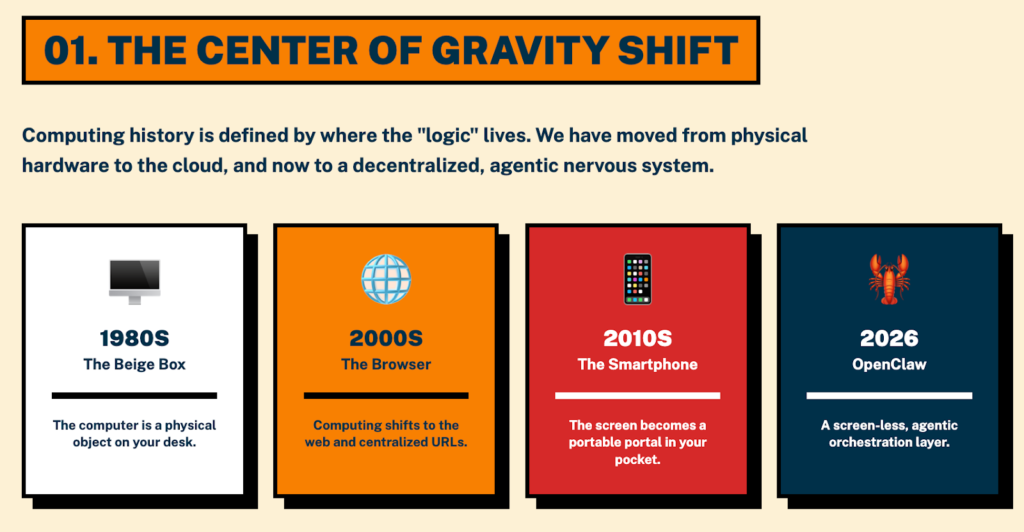
The history of computing is defined by the shifting “center of gravity.” In the 1980s, the computer was a beige box on your desk. In the 2000s, it was the web browser. In the 2010s, it was the smartphone. But as we sit in the first quarter of 2026, the definition of a “computer” has undergone its most radical transformation yet.
It isn’t a piece of hardware. It isn’t a screen. It’s a lobster-themed, open-source orchestration layer called OpenClaw. By the way, you can easily start experimenting with it simply by getting a Mini PC for OpenClaw.
If you’ve spent any time on GitHub or Tech Twitter recently, you’ve seen the meteoric rise. With over 330,000 stars and a community that has effectively “vibed” a new operating system into existence, OpenClaw (formerly Clawdbot and Moltbot) is no longer just a trending AI project. It is the first true Agentic OS.
As a journalist who has covered everything from the first iPhone launch to the LLM explosion of 2023, I’ve seen many “next big things” fizzle out. But OpenClaw is different. It represents a fundamental shift from generative AI to agentic AI—from a machine that talks to a machine that does.
What is OpenClaw? (And Why “Computer”?)
At its simplest, OpenClaw is an open-source autonomous AI agent that runs locally on your hardware. Developed by Peter Steinberger and now maintained by an independent foundation (after Steinberger’s high-profile move to OpenAI), it acts as a “gateway” between large language models (LLMs) and your digital life.
But calling it an “AI agent” is like calling the first Macintosh a “fancy calculator.”
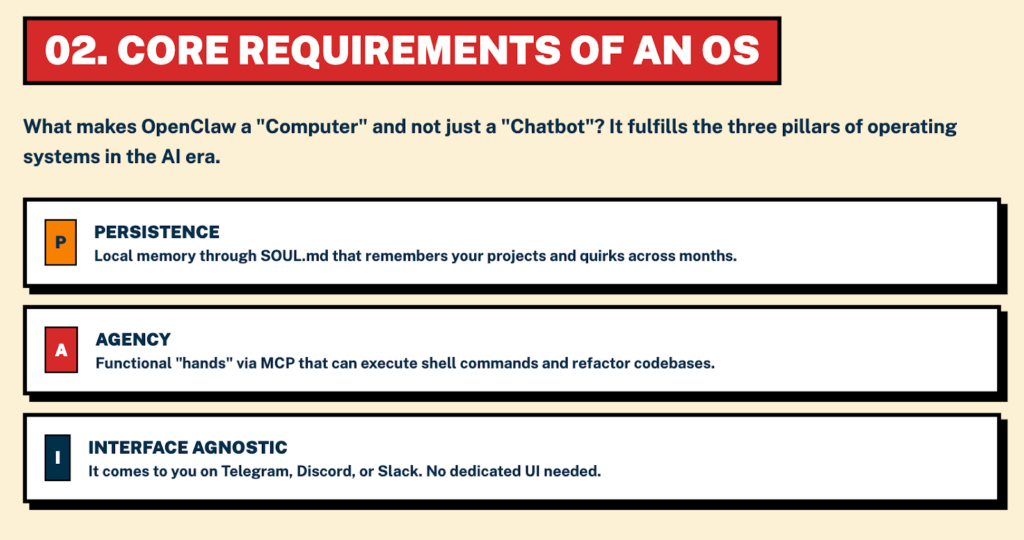
OpenClaw is the “New Computer” because it fulfills the three core requirements of an operating system in the AI age:
- Persistence: Unlike ChatGPT, which resets every session, OpenClaw has a “soul”—a SOUL.md file and a local memory system that remembers your preferences, your projects, and your quirks across months of interaction.
- Agency: It has “hands.” Through its skill system and the Model Context Protocol (MCP), it can read and write files, execute shell commands, manage your 1Password vault, and even refactor entire codebases while you sleep.
- Interface Agnostic: You don’t “go to” OpenClaw. It comes to you. Whether you’re on Telegram, Discord, WhatsApp, or Slack, OpenClaw is there, acting as the invisible tissue connecting your apps.
The “Lobster” Revolution: Why Developers are Obsessed
The tech world has a long history of quirky mascots—the Linux penguin, the Android robot. Now, we have the OpenClaw lobster.
In the developer community, the obsession isn’t just about the memes. It’s about utility. I recently interviewed a solo founder who uses four distinct OpenClaw agents—Milo (strategy), Josh (business), Angela (marketing), and Bob (the “introverted analytical genius” coder). These aren’t just personas; they are functional workers with shared memory who manage his entire startup’s infrastructure via a Discord server.
The Power of Local Execution
In an era of cloud dominance, OpenClaw’s “Local-First” philosophy is its secret weapon. By running the gateway on your own machine (or a private VPS), your most sensitive data—emails, calendars, SSH keys—never has to leave your control. You bring your own API key (Claude 4.6, GPT-4o, or a local DeepSeek model via Ollama), and OpenClaw provides the “nervous system.”
This architectural choice has sparked a hardware renaissance. We are seeing a surge in “Lobster Boxes”—dedicated Mac Minis or Raspberry Pi clusters—built solely to run OpenClaw 24/7. Even NVIDIA has entered the fray with NemoClaw, an enterprise-grade security layer designed specifically for this ecosystem.
From “Copilot” to “Autopilot”: The 13.37% Problem
However, being the “New Computer” isn’t without its growing pains. Recent research into EvoClaw—a benchmark for autonomous code evolution—revealed a sobering statistic: the continuous development success rate for agents is currently only 13.37%.
This is the “technical debt” of the AI era. While an agent can write a perfect function in seconds, maintaining a complex, living codebase over months is a different beast. We are seeing the limits of current reasoning models when faced with long-term logic and system-wide dependencies.
Yet, as any tech veteran will tell you, a 13% success rate for a machine working autonomously at 3 AM is still infinitely more productive than a human who isn’t working at all. The trajectory is clear: we are moving toward a world where the “developer” is a supervisor of a lobster colony.
The Security Minefield: With Great Power Comes Great Prompt Injection
We cannot discuss OpenClaw without addressing the elephant—or rather, the giant claw—in the room. Because OpenClaw requires broad permissions (email, shell, file system) to be useful, it is a high-value target for cybercriminals.
The CVE-2026-25253 vulnerability, which allowed remote code execution via a simple Telegram message, was a wake-up call. Security firms like Cisco and Malwarebytes have issued stern warnings. “Treating OpenClaw as a hardened productivity tool is wishful thinking,” noted one recent report. It behaves like an “over-eager intern with an adventurous nature and no real understanding of privacy.”
We are seeing a new layer of the tech stack emerge to solve this: AI Permission Firewalls. Startups like Jentic are launching “killswitches” and credential controls to ensure your agent doesn’t accidentally mail your tax returns to a hallucinated recipient.
How to Get Started: The “New Computer” Setup
If you’re ready to move beyond the browser and into the agentic era, setting up your “New Computer” is surprisingly simple.
- The Environment: You’ll need Node.js 22+. While it runs on macOS and Linux natively, Windows users will need WSL2.
- The Install: A simple one-liner: curl -fsSL https://openclaw.ai/install.sh | bash.
- The Brain: Plug in your API keys. While OpenClaw is model-agnostic, the community currently favors Anthropic’s Claude series for its superior “computer use” capabilities.
- The Skills: Browse ClawHub. Whether you need a skill to summarize your 10,000 unread emails or one to build a meal plan based on your Kroger history, the community has likely already built it.
The Future is Decentralized and Autonomous
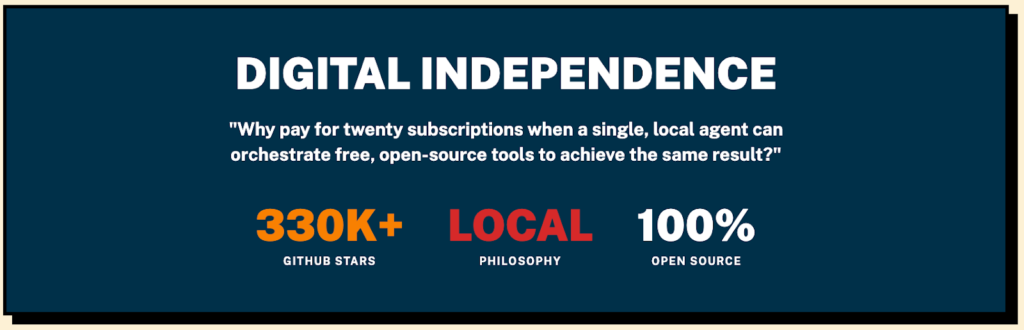
The rise of OpenClaw signals the end of the “SaaS Era” as we know it. Why pay for twenty different subscriptions when a single, local agent can orchestrate free, open-source tools to achieve the same result?
OpenClaw isn’t just a piece of software; it’s a declaration of digital independence. It returns the power of computing to the individual, powered by the collective intelligence of the world’s best models.
The “New Computer” doesn’t have a screen. It has a heartbeat, a memory, and a lobster logo.