 Backlinks Hub
Introduction
Most organizations don’t fail because of a lack of ambition. They fail because the path between a big idea and real results gets messy. A strategy is approved, even though everyone agrees in the meeting, and then… the execution turns into a dozen scattered projects, conflicting priorities, and “urgent” work that somehow wasn’t urgent last week.
Why do these happen? According to a 2016 PMI study, $122 million is wasted for every $1 billion invested in strategic initiatives due to poor performance. That’s not a small leak; it’s a major drain. This is exactly where program management and PgMP-certified professionals’ thinking becomes useful: they focus on turning strategic intent into coordinated, measurable outcomes. But how? Let’s look deep into this article.
Strategy vs. Execution: What’s Really Getting Missed?
| Strategy is the “what” and “why.” Execution is the “how” and “when.” |
The gap happens when strategy stays at a high level (“grow market share,” “transform customer experience”), but the organization struggles to translate those goals into the right portfolio of projects and programs. Organizations mostly struggle to identify, resource, and manage the programs and projects that actually make strategy real.
In simple terms:
| Strategy says, “We are going there.” Execution says, “Great… but which road, which vehicle, and who’s driving?” |
PgMP: The “Bridge Builder” Role
A project delivers a specific output (like launching a new app feature).
A program manages multiple related projects together to deliver bigger benefits (like improving customer onboarding end-to-end).
That’s the key difference.
A PgMP-certified professional is trained to connect corporate goals to real work in progress, so the organization doesn’t just complete projects, but completes the right set of projects that produce intended value.
A Practical Framework: How Strategy Turns into Work (Without Assumption)
As per the Project Management Institute, one useful model is called the Strategic Execution Framework (SEF). It explains strategic execution through six connected domains, remembered as INVEST:
- Ideation
- Nature
- Vision
- Engagement
- Synthesis
- Transition
Instead of treating strategy as a slide deck, this framework treats strategy as a system that must be designed, funded, executed, and operationalized.
Where PgMP Makes the Biggest Difference (In Real Life)
1) It helps teams stop working in silos
A major reason strategy fails is that planning is mostly conducted in separate departments with limited coordination. The ProjectManagement.com article highlights the pain of a lack of a cross-functional approach, where business unit plans may even conflict with each other.
PgMP-style program management forces the conversation back to:
“How do these teams move together toward one business outcome?”
Not in theory; in schedules, dependencies, and shared ownership.
2) It adds context so people understand the “why.”
Another execution killer isa lack of context. People receive a goal, but not the meaning behind it. The same article points out that initiatives must answer why they matter, because “why” creates buy-in, not just compliance.
A PgMP program manager doesn’t just assign tasks.
They translate strategy into a story people can act on:
- What success looks like
- Why this matters now
- What decisions are non-negotiable
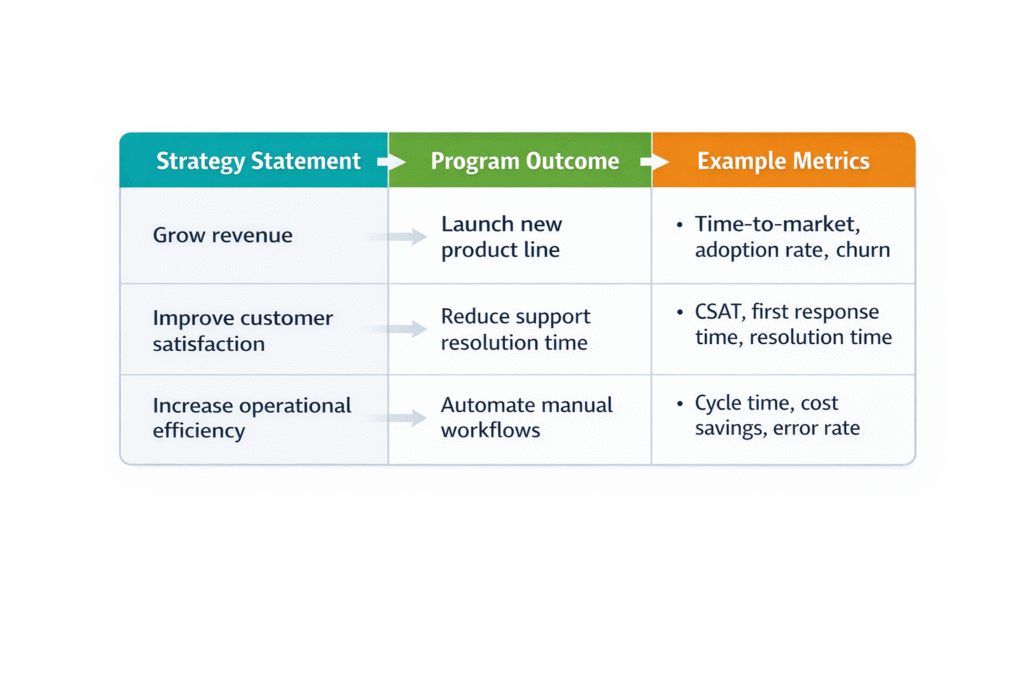
3) It turns vague goals into measurable operational outcomes
Many strategies won’t work because goals sound impressive but don’t translate into daily execution. The objectives must be turned into meaningful operational measurements, not abstract statements.
Instead of “become an industry leader,” program management pushes questions like:
- How many customers must we acquire?
- What cycle time must improve?
- What new capabilities must go live, and when?
This is where strategy stops being motivational and begins to become actionable.
Funding the Right Work (Not Just Busy Work)
As per the SEF framework, execution depends on selecting and funding the right set of projects and programs within the portfolio.
It’s not enough to execute well.
You also need to execute the right things.
This matters because organizations have limited capacity. Strategic success depends on directing resources for maximum advantage, not trying to do everything.
PgMP professionals are trained to handle this kind of trade-off thinking, where decisions are made based on outcomes, not noise.
The “Execution Reality Check”: Planned vs. Actual Work
Even good plans can fail sometimes.
The Synthesis as the point where organizations ensure the planned portfolio matches what is actually being executed. Any gap between the two threatens strategic success.
This is where PgMP adds real control:
- Are teams still working on what was approved?
- Are priorities still aligned with the strategy?
- What should be accelerated, paused, or stopped?
It’s not micromanagement. It’s alignment maintenance.
Turning Delivery Into Operations (Where Value Finally Shows Up)
One of the most underrated parts of execution is the handoff.
Transition is the ultimate measure of success: moving project outputs into operations.
Organizations mostly lose value due to poor change management during transition into “business as usual.”
Enhancing skills through PgMP certification, because it develops the thinking that supports a smoother transition by planning for:
- adoption
- operational readiness
- stable performance measures
- feedback and improvements
Because a project isn’t “done” when it’s delivered; it’s done when it works in real life.
Final Thoughts: What PgMP Really Adds
PgMP doesn’t magically fix broken strategies. But it gives organizations a repeatable way to connect intent to outcomes. It helps leaders and teams:
- Align cross-functionally
- Measure what matters
- Fund the right initiatives
- Manage execution as a coordinated program
- Deliver benefits that survive the handoff to operations
If your organization has great ideas but inconsistent results, PgMP-style program management is less about adding paperwork and more about making execution feel less random and more intentional.
That’s the bridge. And it’s worth building.