 admin
admin
When selecting a jewelry manufacturer, skipping proper vetting can lead to quality issues, missed deadlines, intellectual property risks, and unnecessary costs. These problems often surface only after production begins, when they are harder and more expensive to fix.
For this reason, vetting should be treated as a return-driven step, not overhead. This article outlines how to evaluate a jewelry manufacturer before placing an order.
Phase One: Know Where to Look
The first step in any serious vetting process is knowing where to find manufacturers worth evaluating in the first place. Not all sources are equal, and where a manufacturer shows up tells you something about them before you have even made contact.
- Trade Directories
Platforms like Alibaba, Made-in-China, and Global Sources list thousands of jewelry manufacturers in China and beyond. The volume can be overwhelming, but these platforms do offer useful filters: years in business, verified supplier status, export volume, and response rate. Use them as a starting point. Note that a verified badge on Alibaba confirms that a business exists, but it does not confirm that they are capable of producing to your standards.
- Trade Shows
Face-to-face interaction remains one of the most reliable ways to evaluate a jewelry manufacturer. Trade shows like Hong Kong Jewellery & Gem Fair (held in March and September), the JCK Las Vegas Show, and the Canton Fair in Guangzhou bring together manufacturers from across the production spectrum. The ability to see physical samples, meet production teams directly, and have unscripted conversations about capacity and lead times is genuinely difficult to replicate through email or video calls.
- Factory Websites
A manufacturer’s website provides deeper insight into its actual capabilities. Look for specific details such as production processes, material focus, certifications, sample timelines, and minimum order quantities. Vague claims like “high quality” and “fast delivery” mean nothing. Specific claims with evidence mean a great deal.
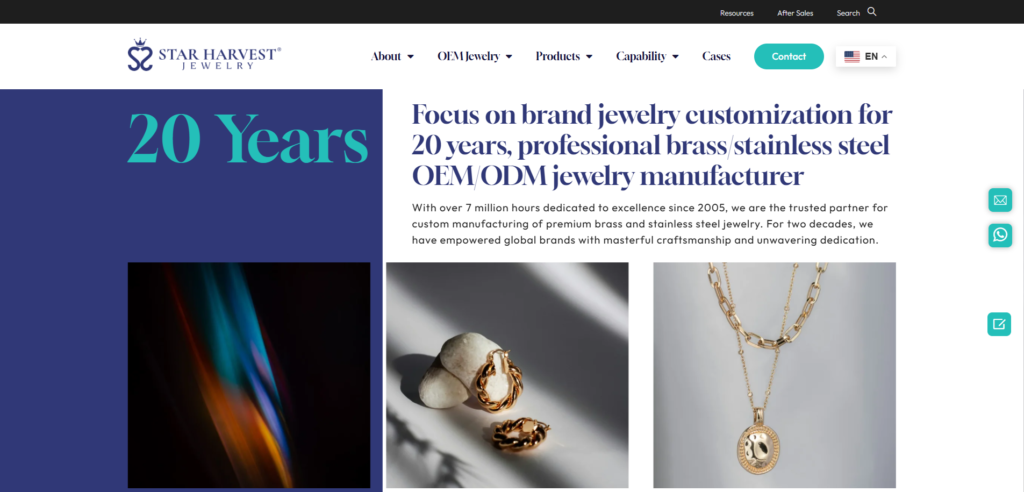
Star Harvest’s website is a useful example of what transparency looks like in practice. Their site documents monthly output of 500,000 pieces, a 97% on-time delivery rate, nine quality inspection stages, plating thickness standards verified by X-ray fluorescence (≥0.08μm), salt spray testing in excess of 72 hours, and tensile load testing on structural components. Certifications such as RJC, SGS, and ISO are listed alongside the audit bodies that issue them. That level of specificity signals a manufacturer that operates with documented, verifiable processes.
Phase Two: Verify Before You Sample
Once a shortlist of candidates is in hand, the next step is qualification checking — a structured review of what each manufacturer can actually deliver before a single sample is requested. This phase is about eliminating risk.
- Certifications
Check whether the manufacturer holds relevant certifications, such as ISO for quality management or SGS reports for material and product testing. These certifications indicate that the company follows defined processes and can meet compliance requirements in different markets.
- Production Capacity
Review the manufacturer’s production capacity, including monthly output and ability to scale. A supplier that handles large jewelry volumes is better suited for brands planning to grow beyond small orders.
- Minimum Order Requirements
Always confirm the minimum order quantity from the manufacturer. Some manufacturers require higher volumes, while others allow smaller initial runs.
- Communication Responsiveness
Evaluate how quickly and clearly the manufacturer responds. Delayed or unclear communication during the early stage often reflects how issues will be handled during production.
- Client References
Ask for past client references or examples of previous work. This can include product photos, case studies, or testimonials.
Phase Three: Test Everything Before You Scale
After completing initial checks, the next step is to test the custom jewelry manufacturers through sampling. This stage helps confirm whether the supplier can meet your requirements in actual production. Here is what to do at this stage:
- Request Samples
Start by requesting samples based on your design or existing product specifications. This allows you to evaluate how accurately the manufacturer can translate design requirements into a finished product.
- Evaluate Quality against Spec
Compare the sample against its required technical specifications. Check factors such as dimensions, finishing quality, plating consistency, stone setting, and overall workmanship.
- Assess Packaging and Shipping
Review how the sample is packaged and delivered. Proper packaging indicates attention to product protection during transit, while shipping timelines reflect the manufacturer’s ability to meet delivery expectations.
- Place a Trial Order Before Scaling
Before committing to full production, place a small trial order. This helps verify consistency across multiple units. It also allows you to evaluate production timelines, communication during manufacturing, and the jewelry supplier’s ability to deliver according to agreed specifications.
Build a System, Not a Checklist
The brands that consistently find and keep excellent manufacturing partners do not vet every factory from scratch. They build a system — documented criteria, a standard sample evaluation template, a set of reference questions for client calls, and a structured trial order process — and they apply it consistently every time a new supplier enters the picture. The right jewelry manufacturing partners will pass it without difficulty.
Read More at USA Times